How to replace a ceiling light fixture
Short answer
Replace a ceiling light only like-for-like: the same place, the same box, the same wires, the same switch. Difficulty 3 of 5; for a first-timer, plan on about half a day. Read the “Stop here” box below before step 1.
Draft guide written from standard practice, not yet reviewed by a licensed pro. Follow product labels where they differ.
Switch the breaker off and prove every wire dead with two testers, look in the box before you touch a wire and stop at any warning sign, take the old fixture down, mount the new bracket and connect the ground, wire it the way it was, hang the fixture, then test at the switch.
Difficulty 3 of 5 · about half a day · careful
Stop here
Photo of your room, the look you pick, then this guide with the materials counted for your room.
What you need
- Ceiling light fixture
- Wire connectors rated for your wires
- Bulbs within the fixture's maximum wattage
- Green ground screw
Tools
- Non-contact voltage tester — the one tool you do not skip
- Two-lead voltage tester or multimeter (confirms what the non-contact tester says)
- Insulated screwdrivers, flat and Phillips
- Wire strippers
- Step ladder
- Headlamp or a work light on another circuit
- Safety glasses
- A helper for a heavy fixture
Step by step
Step 1 of 9
Read the stop-gate before you buy anything
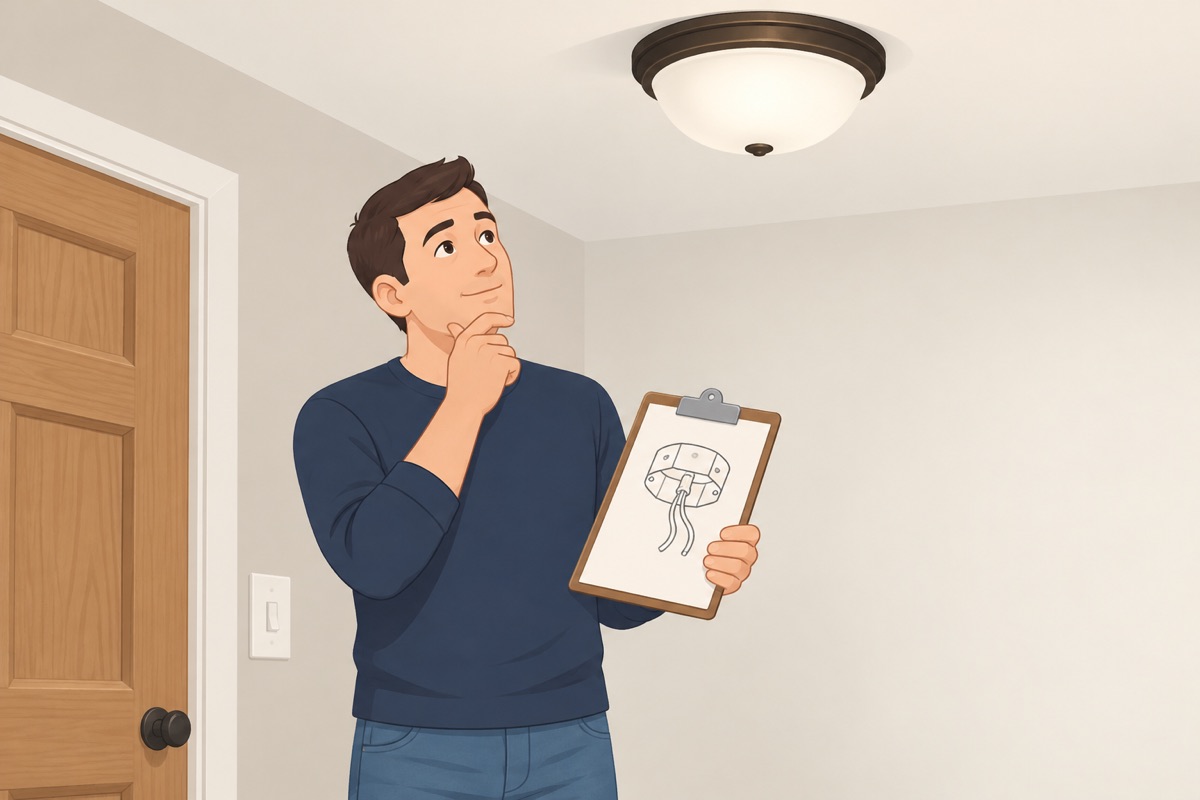
This job takes down a ceiling fixture and puts up a new one in the same place, on the same box, on the same wires, worked by the same switch. A new place, a new box, a new switch or dimmer, or a ceiling fan is a licensed electrician's job or its own guide. You will look into the box before you touch a single wire (step 4): what you find there decides whether you go on.
Step 2 of 9
Buy a fixture that fits the box and the room
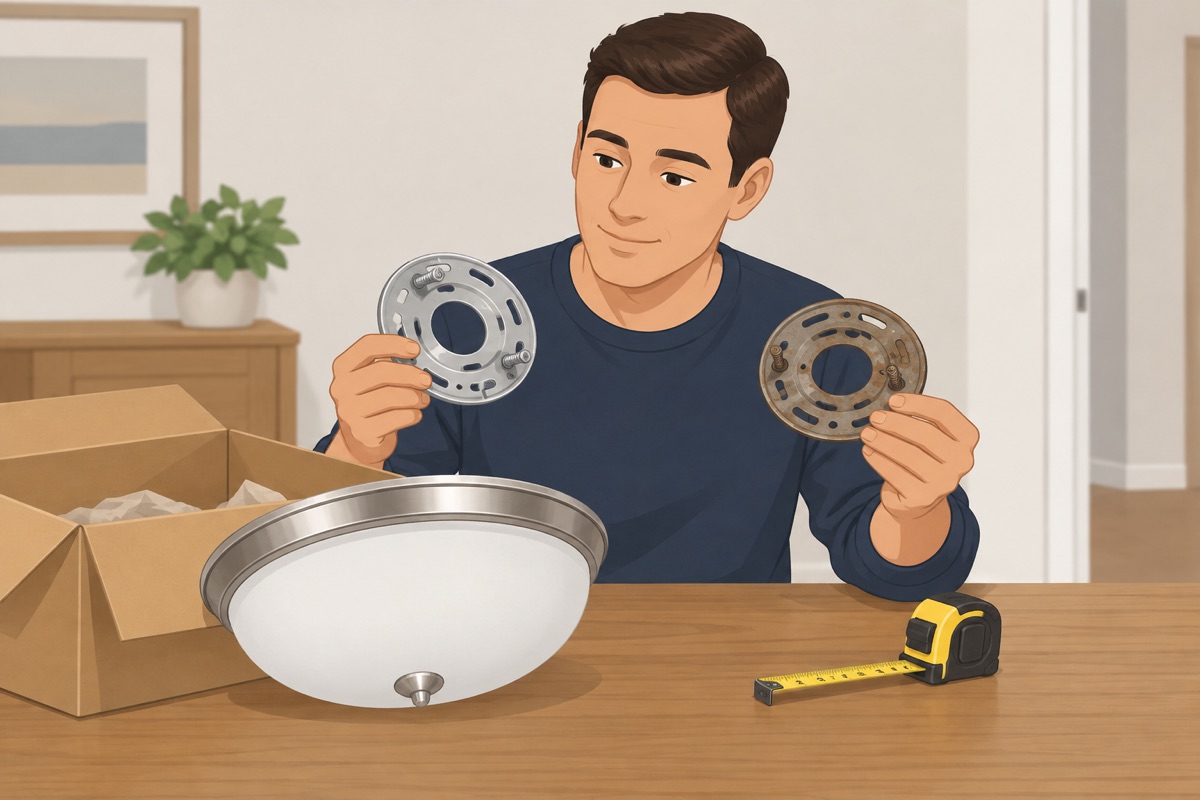
Read the new fixture's box: its weight, the mounting it comes with, and its location rating — in a bathroom, a fixture over or near the tub or the shower must be rated for that spot. Check that its canopy covers the old fixture's outline on the ceiling. A heavy fixture or a chandelier needs a box and support marked for that weight; if you do not know what your box carries, ask an electrician before you buy.
Is this a like-for-like swap?
- The new fixture goes in the same place as the old one, on the existing box — the old one hangs on a box too, not a recessed can or a track
- It is worked by the same wall switch — no switch, dimmer, or smart switch is added or rewired
- No new circuit, no new box, and no new cable is needed
- The new fixture is a light, not a ceiling fan
- In a bathroom: the fixture's label rates it for its spot — or this is not a bathroom
Step 3 of 9
Breaker off, then prove every wire dead
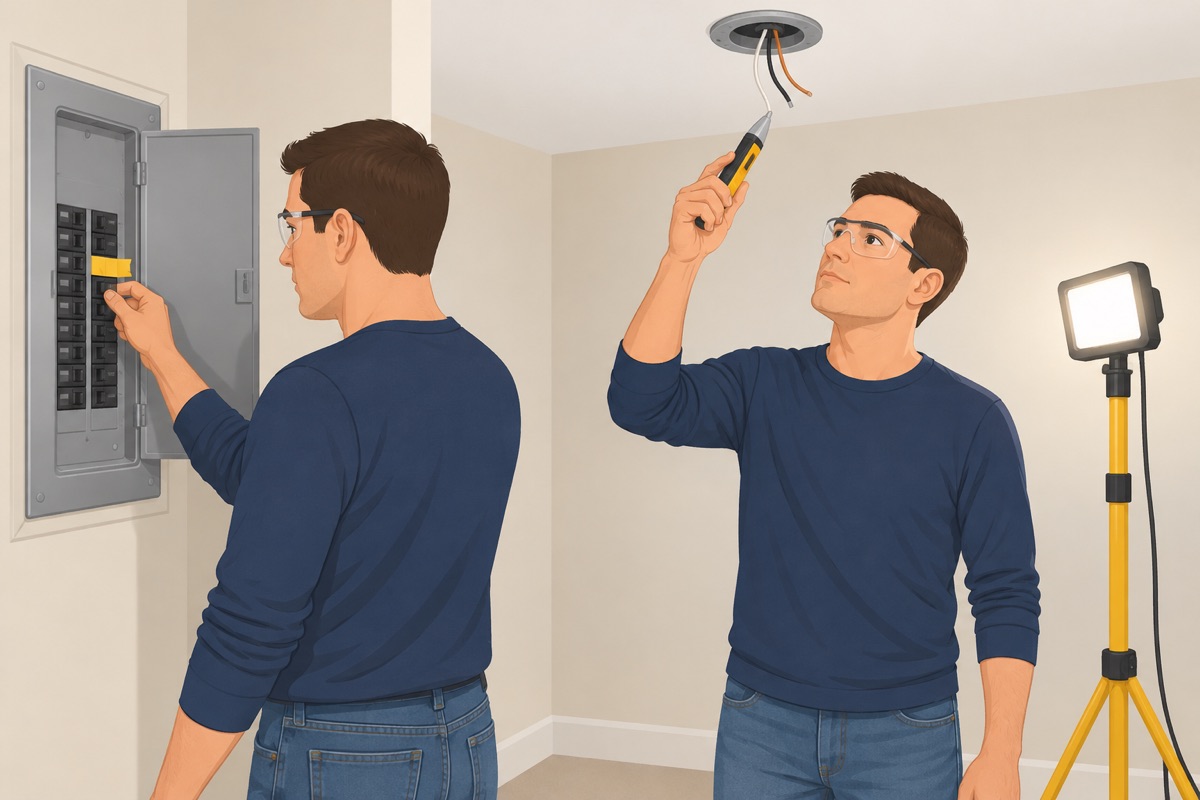
Turn the light on, find the breaker that turns it off, switch it off, and tape it so nobody flips it back. Turn the wall switch off too. Set up your own light that is not on this circuit. Check the non-contact tester on a live outlet. Take off the globe and the bulbs, loosen the canopy, and hold the fixture by its body, never by the wires. Test every wire in the box with the non-contact tester, then each pair and each wire to ground with the two-lead tester. Check the tester on the live outlet again. Any wire that still reads live: stop, put the canopy back, and call an electrician.
Power off and proven
- The breaker is off and taped, and the wall switch is off
- The non-contact tester worked on a live outlet before and after the test
- Every wire in the box tested dead with the non-contact tester
- Every pair, and every wire to ground, tested dead with the two-lead tester
- A steady ladder, safety glasses, and your own light that is not on this circuit
Step 4 of 9
Look in the box before you touch a wire
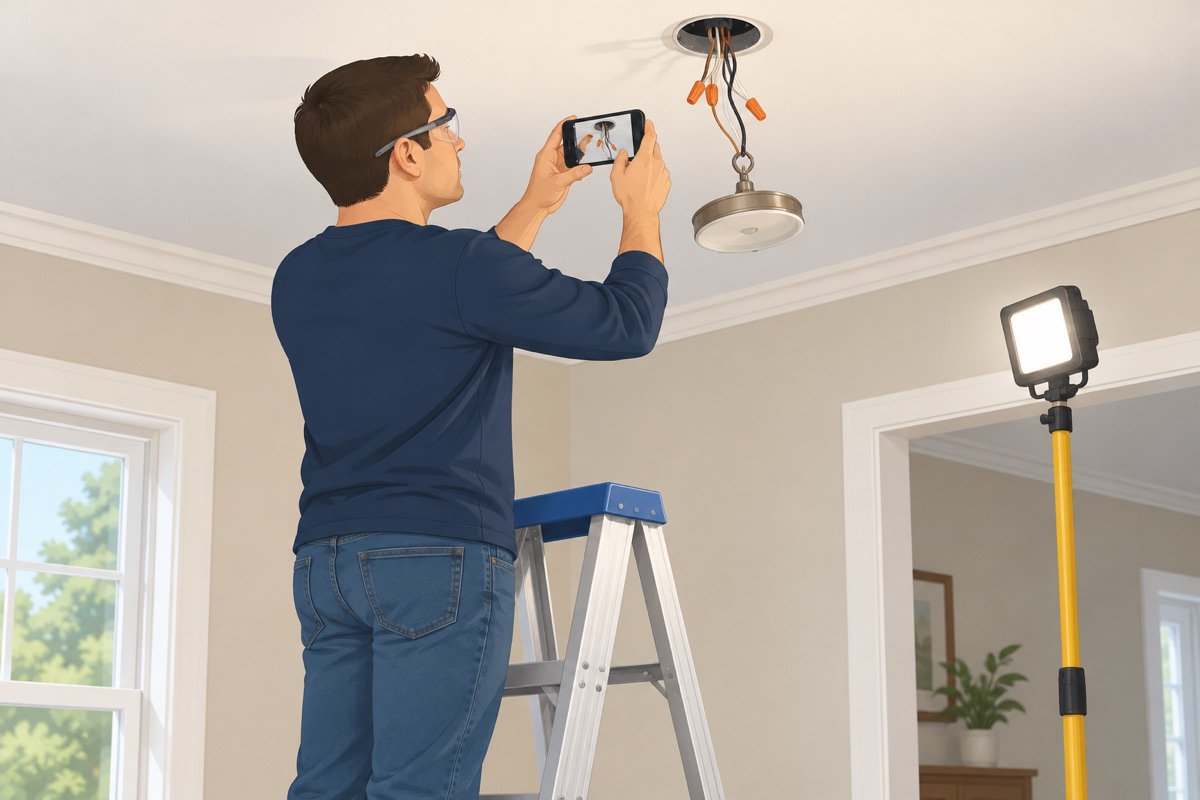
Photograph the connections before you undo anything. Then look, without touching: aluminum wire, knob-and-tube, cloth or crumbling insulation, no ground wire, scorch marks or melted plastic, a loose or cracked box, a box crammed with more wires than you can explain, or a heavy fixture going on a box that is not marked for its weight. Any one of these is a hard stop: do not undo a single connector, put the old fixture back up the way it was, and call a licensed electrician.
Before you touch the wires
- A photo of the connections is on your phone
- The wires are copper with sound insulation — no aluminum, no knob-and-tube, no cloth or crumbling insulation
- There is a ground wire in the box
- No scorch marks, melted plastic, or burnt smell
- The box is tight and not cracked, and it carries the new fixture's weight per the box's marking and the fixture's instructions
- You can say what every wire in the box does, and they match a simple black, white, and ground hookup
Step 5 of 9
Take the old fixture down
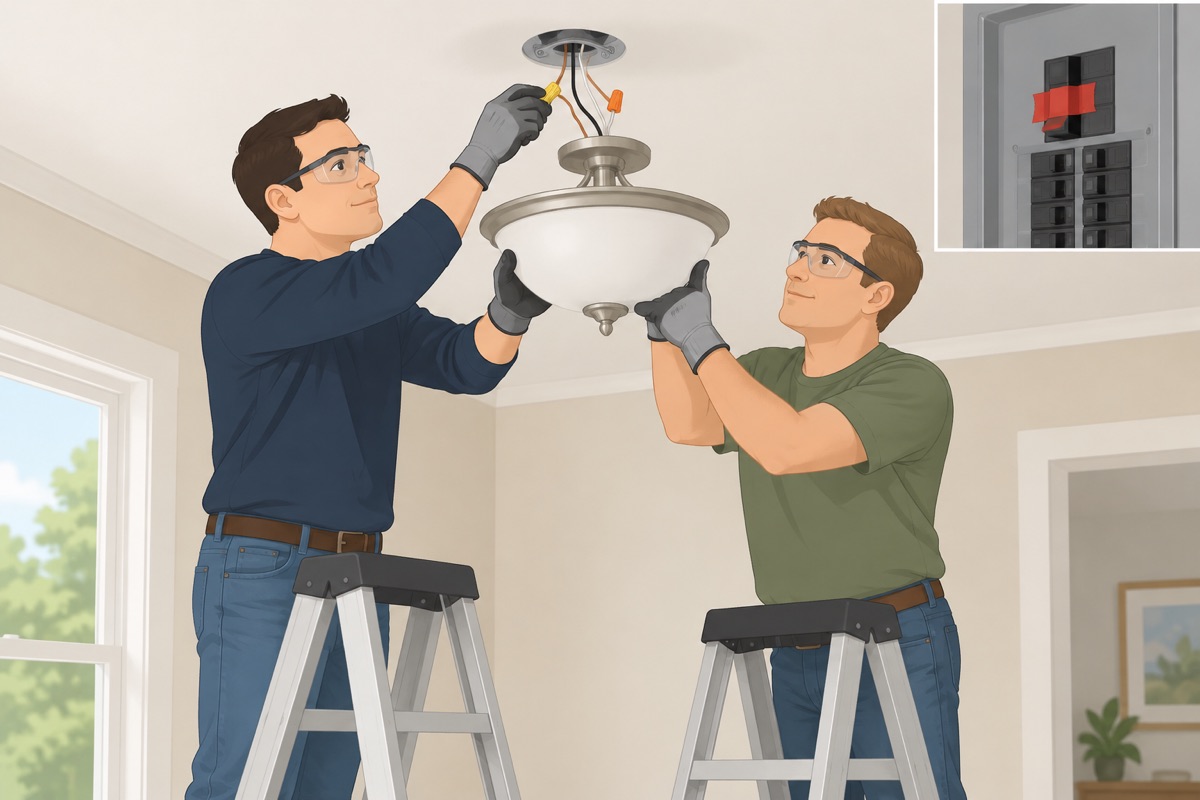
Hold the fixture's weight — a helper on a second ladder for anything heavy. Undo the wire connectors and separate the fixture's wires from the house wires, keeping the house wires apart from each other. Unscrew the old mounting bracket. Push on the box: it must not move.
Step 6 of 9
Mount the new bracket and connect the ground
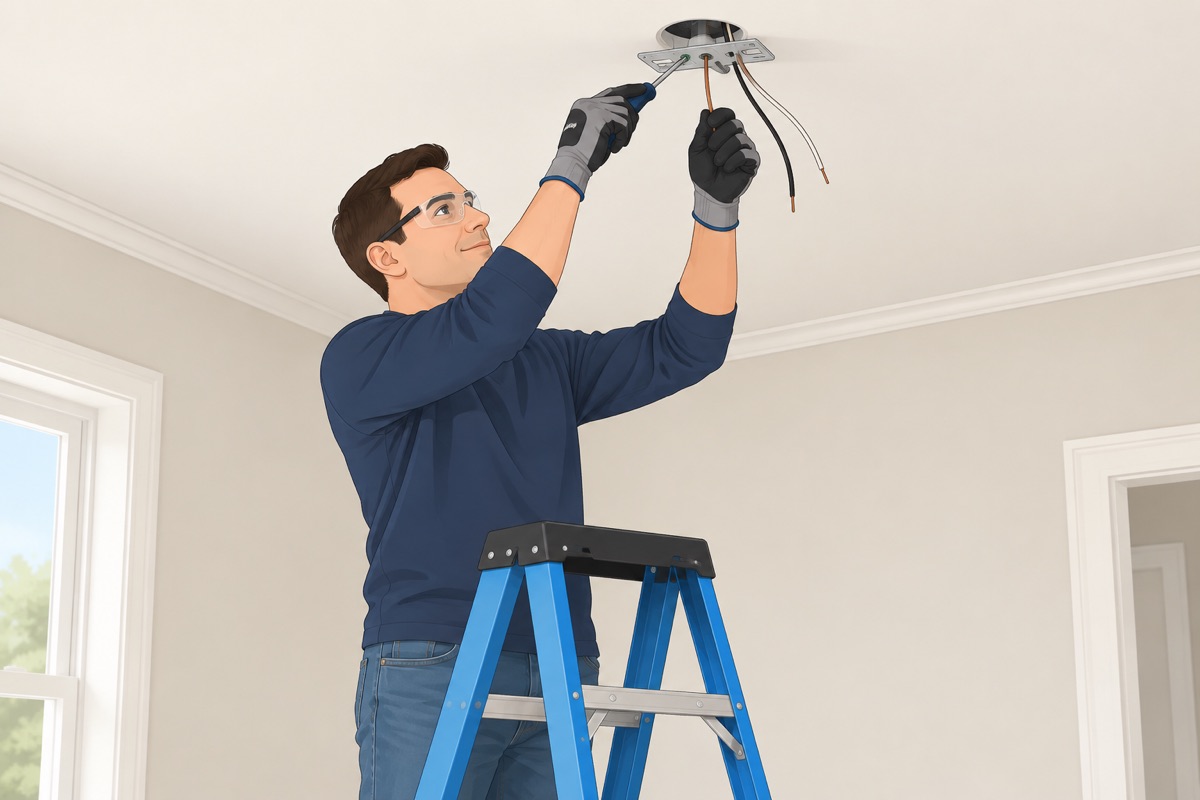
Screw the bracket that came with the new fixture to the box with the screws its instructions name, so it sits flat and tight. Connect the house ground and the fixture's ground to the bracket's green screw, or join them with a wire connector and a short ground lead to the green screw, the way the instructions show.
Step 7 of 9
Wire it the way it was
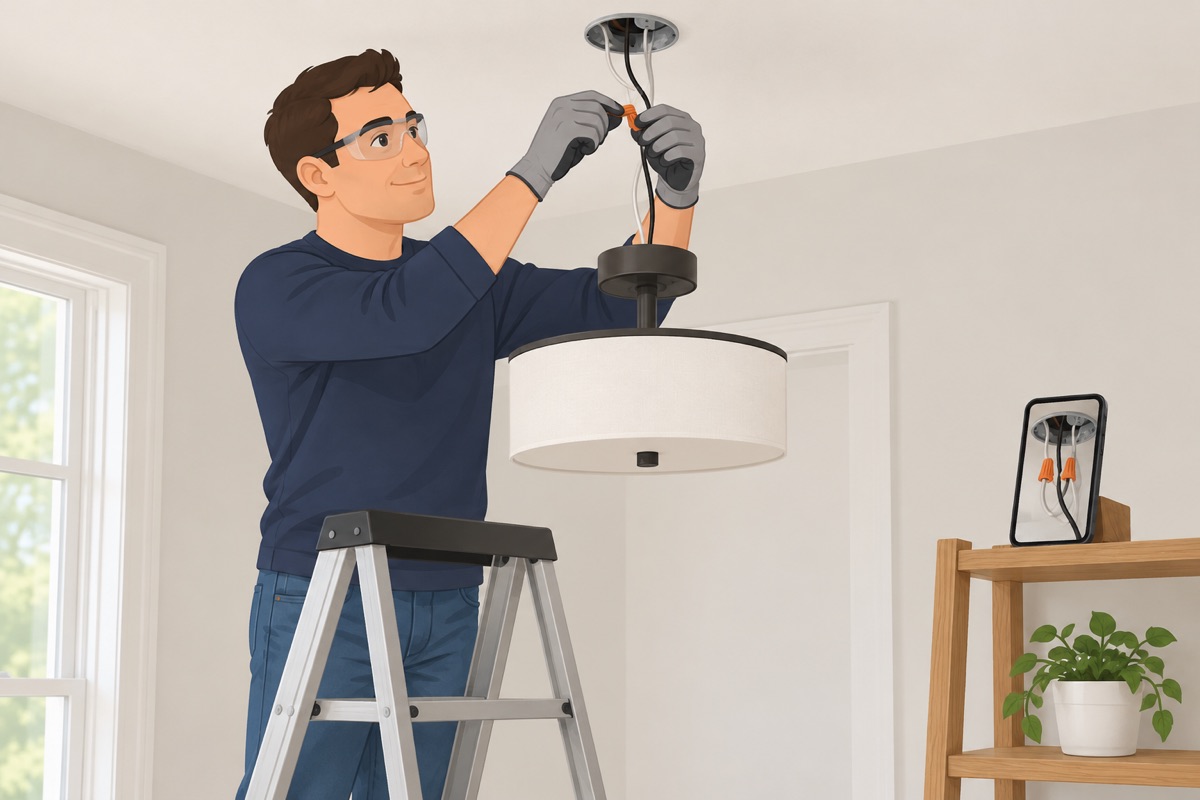
Following your photo and the fixture's instructions: the fixture's white to the house white, the fixture's black to the house black, each with a wire connector rated for those wires, twisted tight with no bare copper showing below it. Tug each wire. If the house wires are not one black, one white, and a ground, or they do not match your photo and the instructions, stop — that is an electrician's call. Fold the wires neatly into the box.
Step 8 of 9
Hang the fixture and fit the canopy
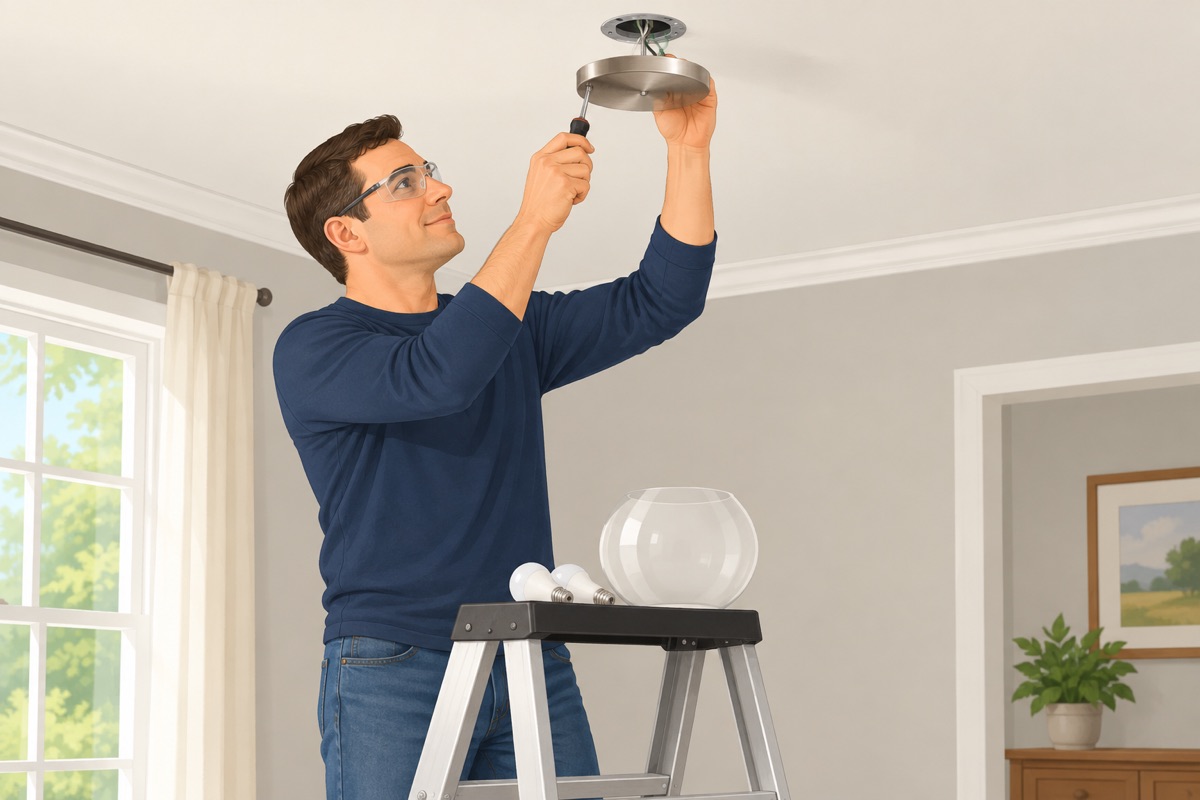
Lift the fixture to the bracket and fasten the canopy as the instructions say, with no wire pinched between the canopy and the box. Fit bulbs no stronger than the fixture's label allows, then the globe or the shades.
Step 9 of 9
Breaker on, then test at the switch
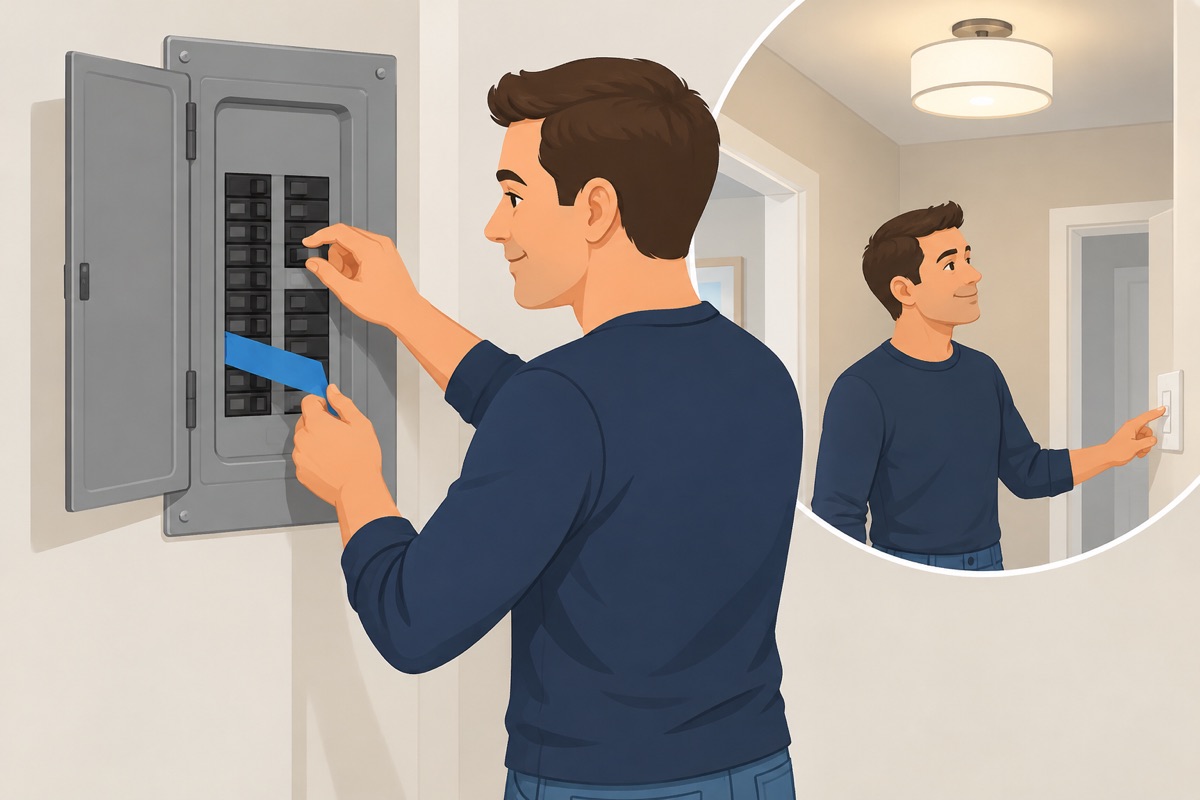
Take the tape off and switch the breaker on. Work the wall switch several times: the light comes on and goes off with the switch, every time. Let it run for a while. Flicker, buzzing, a warm canopy, a burnt smell, or a breaker that trips: switch the breaker off and call an electrician.
Quality check
- The light turns on and off with its wall switch, every time
- No flicker, buzzing, burnt smell, or warm canopy after it has run for a while
- The breaker has not tripped
- The fixture is tight to the ceiling, with no wire showing and none pinched
- The bulbs are within the wattage on the fixture's label
Common mistakes
- Trusting the switch or the breaker label. A ceiling light can be fed through another box, a second switch, or a mislabeled breaker. Test every wire in the box with both testers, and check the tester on a live outlet before and after. Mistake #1 in this task.
- Hanging a heavy fixture on a light-duty box. A ceiling box carries a fixture only up to the weight it is marked for. A heavier fixture, or a ceiling fan, needs a box and support made for it; on the wrong box it can pull out of the ceiling.
- Leaving the ground off. The ground is what trips the breaker if a wire touches the metal fixture. Connect it to the bracket's green screw and to the fixture's ground. No ground wire in the box is a stop.
- A loose wire connector. A connector that is not twisted tight, or that leaves bare copper showing, can work loose and heat up inside the box. Twist it tight, tug each wire, and use a connector rated for the wires you are joining.
- Bulbs stronger than the label. Every fixture has a maximum on its label. A stronger bulb overheats the socket and the wires in the box. Stay within the label.
Questions
How do I replace a ceiling light fixture?
Turn the breaker off, tape it, and turn the wall switch off. Test every wire in the box with a non-contact tester, then each pair and each wire to ground with a two-lead tester, checking the tester on a live outlet before and after. Photograph the connections and look in the box before you touch a wire. Then take the old fixture down, screw the new bracket to the box, connect the ground, join white to white and black to black with rated wire connectors, hang the fixture and test at the switch.
What should I look for in the ceiling box before I change a light?
Aluminum wire, knob-and-tube, cloth or crumbling insulation, no ground wire, scorch marks or melted plastic, a loose or cracked box, a box crammed with more wires than you can explain, or a heavy fixture going on a box not marked for its weight. Any one of these is a hard stop: do not undo a connector, put the old fixture back up the way it was, and call a licensed electrician.
Can I put a ceiling fan or a heavier fixture where my light was?
Not with this guide. A ceiling fan has its own guide and needs a box made for a fan. A heavy fixture or a chandelier goes only on a box and a support marked for that weight, per the fixture's instructions; if you do not know what your box carries, ask an electrician before you buy.
When should I stop and call a pro?
Like-for-like only: a new ceiling fixture in the same place, on the same box, on the same wires, worked by the same switch. The breaker is off and every wire is tested dead with a non-contact tester, and confirmed with a two-lead tester, before you touch anything. Stop, do not touch the wires, and hire a licensed electrician if you find any of these: aluminum wiring (dull silver solid wire, or AL printed on the cable); knob-and-tube wiring (single wires on ceramic knobs or through ceramic tubes); cloth or crumbling insulation, or wires that crack when bent; no ground wire in the box; scorch marks, melted plastic, or a burnt smell; a box that is loose, cracked, crammed full, or not rated for the new fixture's weight; more cables or wires in the box than you can explain; or a wire that still reads live with the breaker off. Also a licensed electrician's job: a fixture in a new place, a new box, a new circuit or switch, adding or rewiring a dimmer or a smart switch, or a ceiling fan — a fan has its own guide and needs a box made for a fan. Swapping a recessed can or a track light for a hung fixture is not like-for-like either: it needs a new box, so it is an electrician's job. A heavy fixture goes only on a box and a support marked for that weight, per the fixture's instructions. In a bathroom, a fixture over or near the tub or the shower must be rated for that spot on its label. In a building from before 1980, a textured or popcorn ceiling may contain asbestos: do not cut, scrape, or sand it around the box until it has been tested.